St. John's Wort
Hypericum perforatum
Key Compounds
- Hypericin
- Pseudohypericin
- Hyperforin
- Adhyperforin
- Amentoflavone
- Hyperoside
- Rutin
- Isoquercitrin
- Quercetin
- Luteolin
- Caffeic acid
- Chlorogenic acid
Traditional Use
- Mood research — one of the most extensively researched herbs in Western clinical literature; the 2008 Cochrane systematic review (Linde et al., 5,535 patients, 29 trials) is among the largest herb-focused clinical analyses published; in Germany, specific standardised extracts have a distinct regulatory history — regulatory approaches to herbal medicines vary by country
- Traditional European herbalism — recorded use by Dioscorides (1st century CE), Hippocrates, and Galen; medieval European use as a wound herb and for 'melancholy'; named for St. John the Baptist (feast day June 24, when the plant flowers); one of the longest continuously documented plants in the European herbal tradition
- Seasonal mood research — examined in clinical literature in relation to seasonal mood changes associated with reduced light; the light-related application aligns with the plant's historical association with the midsummer solstice festival of St. John
- Topical wound herb — traditional and contemporary use of infused oil for minor wounds and bruises; well-established in European folk medicine; the infused oil has a long history in European herbal tradition
- Antiviral activity — hypericin and pseudohypericin have demonstrated antiviral activity against HIV, herpes, and influenza in laboratory studies; not established as a clinical antiviral treatment at oral doses

Note: This page documents botanical history, traditional uses, and research literature. It is not medical advice and does not constitute a health claim. Herbium does not recommend herbs for any health condition. Consult a qualified healthcare professional before using any herbal preparation.
Hold a St. John’s Wort leaf up to the light.
The leaf looks perforated — dotted with translucent oil glands that pass light through. This is what perforatum means. These are not holes; they are clear oil glands that become visible against backlight. This feature identifies the plant and explains the species name. Dioscorides in the 1st century CE already knew the plant by this feature. It has not changed.
Crush a flower bud between your fingers. The red stain that appears is hypericin — a pigment specific to this plant, visible in the dark glands on the leaves and petals. For centuries, people thought this was the medicinally active compound. Research in the 1990s shifted that understanding: hyperforin, a compound that is colourless and odourless, is the primary driver of the antidepressant effect.
The plant flowers around the summer solstice, close to the feast day of St. John the Baptist. This is why it is named after him.
Meet the plant
A perennial herb, 30–90 cm, with opposite lance-shaped leaves, bright yellow five-petalled flowers, and two raised ridges running along the stem. It grows in dry, sunny conditions — meadows, roadsides, disturbed ground — and is common across Europe and widely naturalised across temperate Asia, North America, and Australia.
In Japan: セイヨウオトギリソウ (Western otogiriso), naturalised in some areas. A native species, オトギリソウ (H. erectum), also exists with similar traditional uses as a wound herb.
| Detail | |
|---|---|
| Family | Hypericaceae |
| Species | Hypericum perforatum |
| Also called | セイヨウオトギリソウ (Western otogiriso, Japan), Tipton’s weed, Klamath weed |
| Life cycle | Perennial herb |
| Native range | Europe, temperate Asia; widely naturalised globally |
| Part used | Flowering tops (buds + flowers + leaves) |
The Cochrane verdict
In 2008, Linde et al. published the most comprehensive systematic review of St. John’s Wort for depression in the Cochrane Database. They analysed 29 randomised controlled trials involving 5,535 patients.
Their review examined comparisons to placebo and to standard antidepressants. The trial population — 5,535 patients across 29 trials — is among the largest in any herbal systematic review published. The analysis found differences in side-effect and discontinuation rates across comparisons.
The review covered mild-to-moderate cases. Severe cases were not the focus. The authors noted important qualifications throughout the review.
Germany has a distinct regulatory history with herbal medicines — specific standardised extracts of St. John’s Wort have regulatory documentation there. This reflects a different regulatory approach to herbal medicine than exists in Japan. Regulatory status in one country is not transferable to another.
The drug interaction problem
This is not minor. Understanding it is mandatory before using the herb.
Hyperforin — the primary active compound — is also a potent inducer of CYP3A4, a major liver enzyme that metabolises approximately 50% of all prescription drugs, and P-glycoprotein, a drug efflux transporter. By inducing these pathways, St. John’s Wort causes the body to metabolise many drugs faster — reducing their blood concentrations and clinical effectiveness.
Documented serious interactions:
- Oral contraceptives: reduced effectiveness. Pregnancies have been reported in women taking St. John’s Wort concurrently with contraceptive pills.
- Antiretrovirals (HIV medications): reduced drug levels, risk of treatment failure.
- Cyclosporine (immunosuppressant for organ transplant recipients): substantially reduced levels, documented cases of transplant rejection.
- Warfarin: reduced anticoagulation.
- Digoxin: reduced levels.
- Certain chemotherapy agents: reduced effectiveness.
If you take any prescription medication, especially any of those listed above, do not take St. John’s Wort without discussing it with your doctor. This is not a precautionary legal statement — it is practical advice based on documented clinical incidents.
The chemistry
Hyperforin is the primary active compound — a phloroglucinol derivative. It inhibits neuronal reuptake of serotonin, dopamine, norepinephrine, GABA, and glutamate simultaneously by inhibiting the Na⁺/K⁺ ATPase pump — a mechanism distinct from SSRIs (which block specific reuptake transporters). Hyperforin is also responsible for the CYP3A4 drug interactions.
Hypericin and pseudohypericin are naphthodianthrone pigments responsible for the red stain. Originally thought to be the primary active compounds; now understood to contribute antiviral activity and to be relevant to mood-related research, but hyperforin is more significant for the latter effects.
Flavonoids (hyperoside, rutin, quercetin, isoquercitrin) contribute antioxidant and anti-inflammatory activity.
| Compound | Class |
|---|---|
| Hypericin | Naphthodianthrone (pigment) |
| Pseudohypericin | Naphthodianthrone |
| Hyperforin | Phloroglucinol (prenylated) |
| Adhyperforin | Phloroglucinol |
| Amentoflavone | Biflavone |
| Hyperoside | Flavonol glycoside |
| Rutin | Flavonoid glycoside |
| Isoquercitrin | Flavonol glycoside |
| Quercetin | Flavonol |
| Luteolin | Flavone |
| Caffeic acid | Hydroxycinnamic acid |
| Chlorogenic acid | Hydroxycinnamic acid |
| Xanthones | Xanthone (trace) |
What people actually do with it
Standardised extract (clinical form): Extract standardised to 0.3% hypericin and/or 3–5% hyperforin — the standardisation used in most clinical trials. Follow product labelling for quantity. Allow 4–6 weeks before evaluating effects.
Tea: Steep 2–3 teaspoons of dried flowering tops in hot water for 10 minutes. Lower and less standardised hyperforin content than extract. Traditional form.
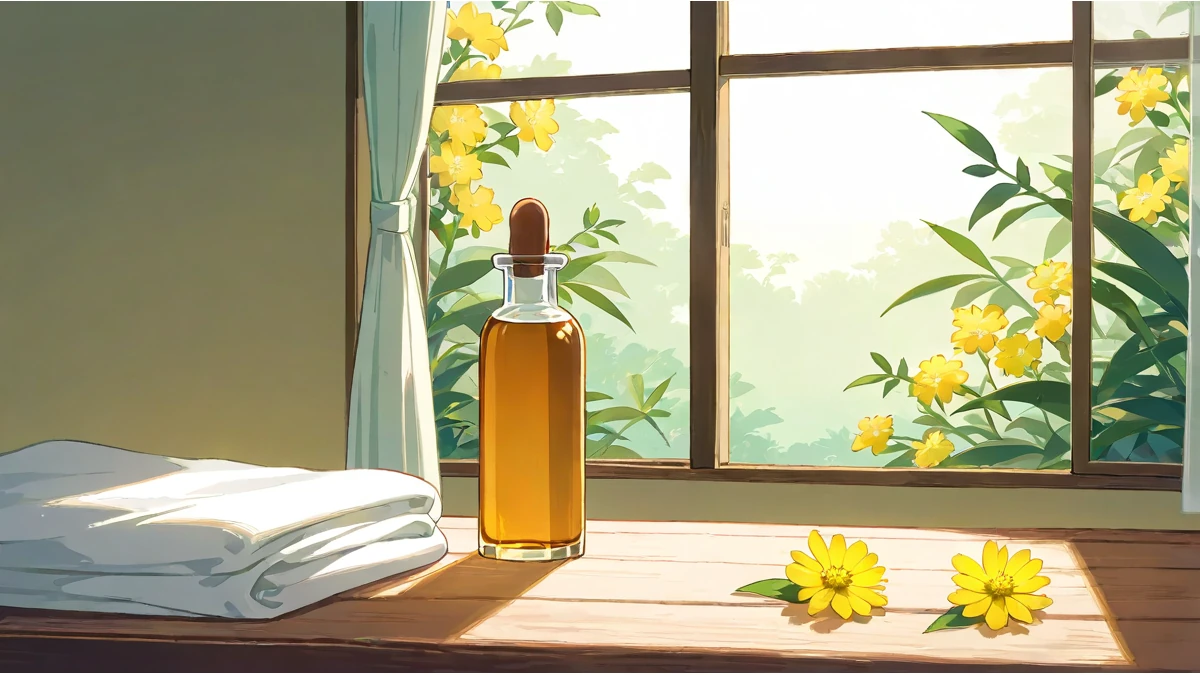
Infused oil (topical): Dried flowering tops steeped in olive oil in sunlight for 4–6 weeks, producing a distinctive red oil. Traditional wound herb and nerve pain application. No systemic drug interactions when used topically.
Tincture: 2–4 mL, three times daily. Fresh plant tincture is considered superior; hyperforin is relatively unstable and degrades in storage.
Could you grow this yourself?
Yes. St. John’s Wort grows readily across most Japanese conditions.
The plant prefers dry to moderately moist, well-drained soil in full sun. It tolerates a wide range of soil types. Grows from seed (surface sow) or division. Seeds require light to germinate. The plant self-seeds readily and can become persistent in a garden.
Harvest the flowering tops when the flowers are just opening — this is when hypericin and hyperforin content is highest. Use fresh or dry quickly at low temperatures. Dried material degrades faster than most herbs due to hyperforin instability.
Hypericum perforatum (セイヨウオトギリソウ) has naturalised in some parts of Japan. The native H. erectum (オトギリソウ) is more common and has similar traditional uses.
St. John’s Wort (セントジョーンズワート) in Japan
Japan has its own Hypericum tradition. The native オトギリソウ (H. erectum) — the ‘slanderer’s herb’, from a legend about a brother who revealed a plant’s secret healing properties and was killed for it — was used traditionally as a wound herb and for bruising and pain. The name is specific and old; the legend is documented.
The European H. perforatum (セイヨウオトギリソウ) is not a classical Japanese medicinal herb. It has naturalised in disturbed ground in parts of Japan and is available as a Western herbal supplement. The antidepressant application is its primary commercial positioning in Japan, marketed through supplement channels rather than through the traditional medical system.
The drug interaction issue is particularly relevant in Japan, where combination prescription drug use is common and some antiretroviral and transplant recipient populations are significant. Japanese pharmacists and physicians are aware of the interaction profile, and guidance is available through the Ministry of Health.
Things you’re probably wondering
What does the research literature show? The 2008 Cochrane systematic review (Linde et al., 29 RCTs, 5,535 patients) is one of the most comprehensive analyses of an herbal product in the clinical literature. Germany has a distinct regulatory history with specific standardised extracts that differs from Japan’s regulatory framework. The drug interaction profile (CYP3A4 induction) is the most clinically significant aspect for anyone taking prescription medication.
Why are the drug interactions so serious? Hyperforin induces CYP3A4 and P-glycoprotein, causing accelerated metabolism of approximately 50% of prescription drugs. Documented clinical incidents: transplant rejection, contraceptive failure, HIV treatment failure.
What is the difference between hypericin and hyperforin? Hypericin is the red pigment (the stain on your fingers when you crush flowers). Hyperforin is the primary antidepressant compound and the main interaction driver. Both are present in good standardised extracts.
Is there a Japanese version? オトギリソウ (H. erectum) is the native Japanese species with similar traditional wound-healing uses. A different plant, similar traditional applications.
Botanical details
| Field | Detail |
|---|---|
| Family | Hypericaceae |
| Species | Hypericum perforatum L. |
| Related species | H. erectum Thunb. (native Japan, オトギリソウ), H. calycinum, H. androsaemum |
| Life cycle | Perennial herb |
| Native range | Europe and temperate Asia; widely naturalised |
| Major producers | Central and Eastern Europe; also Chile, Australia |
| Japan | H. erectum (オトギリソウ) native; H. perforatum naturalised in some areas; available as Western supplement |
| Part used | Flowering tops (harvest when flowers are opening) |
The full compound list
| Compound | Class |
|---|---|
| Hypericin | Naphthodianthrone |
| Pseudohypericin | Naphthodianthrone |
| Isohypericin | Naphthodianthrone |
| Protohypericin | Naphthodianthrone precursor |
| Hyperforin | Prenylated phloroglucinol |
| Adhyperforin | Prenylated phloroglucinol |
| Amentoflavone | Biflavone |
| Biapigenin | Biflavone |
| Hyperoside | Flavonol glycoside |
| Rutin | Flavonoid glycoside |
| Quercetin | Flavonol |
| Isoquercitrin | Flavonol glycoside |
| Luteolin | Flavone |
| Apigenin | Flavone |
| Caffeic acid | Hydroxycinnamic acid |
| Chlorogenic acid | Hydroxycinnamic acid |
| Shikimic acid | Organic acid |
| Xanthones | Xanthone |
See Also
- Valerian — nervine herb for sleep and anxiety; often combined with St. John’s Wort for anxiety-depression overlap
- Ashwagandha — adaptogen for stress and anxiety; useful alternative when drug interactions rule out St. John’s Wort
- Lemon Balm — gentle nervine for mild anxiety; no known serious drug interactions
References
- Linde, K. et al. (2008). St John’s wort for major depression. Cochrane Database of Systematic Reviews, 4, CD000448.
- Kasper, S. et al. (2010). Lavender oil preparation Silexan is effective in generalised anxiety disorder — a randomized, double-blind comparison to placebo and paroxetine. International Journal of Neuropsychopharmacology, 13, 999–1011.
- Borrelli, F. & Izzo, A.A. (2009). Herb-drug interactions with St. John’s Wort. AAPS Journal, 11(4), 710–727.
- Butterweck, V. (2003). Mechanism of action of St John’s Wort in depression: What is known? CNS Drugs, 17(8), 539–562.