Ashwagandha
Withania somnifera
Key Compounds
- Withaferin A
- Withanolide D
- Withanolide A
- Withasomniferin A
- Withanoside IV
- Withanoside V
- Sitoindoside VII
- Sitoindoside VIII
- Withanine
- Somniferine
- Choline
- Anaferine
Traditional Use
- Ayurvedic rasayana — classified as *ashwagandha* in the *medhya rasayana* and general rejuvenative category in Ayurveda; described in *Charaka Samhita* and *Sushruta Samhita*; prescribed as a general tonic, aphrodisiac, and strength-restorer for over 3,000 years
- Stress research — the Chandrasekhar 2012 double-blind RCT (Chandrasekhar et al.) measured serum cortisol directly, an unusual approach in adaptogen research; subsequent trials have examined stress-axis effects; cortisol was a primary measured outcome
- Sleep research — withanolides have been studied in relation to GABA-A receptors; the 2019 Langade RCT examined sleep quality scores with KSM-66 extract; research distinguishes this from sedative mechanisms
- Physical performance — multiple trials showing reduced exercise-induced muscle damage, improved VO₂ max, and increased muscle strength; relevant for athletes and high-stress physical training
- Thyroid research — withanolides are under investigation in relation to thyroid hormone pathways in preclinical studies; clinical data are limited; caution is warranted with thyroid conditions or thyroid medication

Note: This page documents botanical history, traditional uses, and research literature. It is not medical advice and does not constitute a health claim. Herbium does not recommend herbs for any health condition. Consult a qualified healthcare professional before using any herbal preparation.
The name means horse-smell.
Ashwa is Sanskrit for horse. Gandha is smell. The root smells like a horse stable when fresh — sharp, organic, distinctive. The same name was used to mean the horse’s strength would come with it. Smell like a horse, become like a horse. This made intuitive sense in a tradition that was not separating the pharmacological from the symbolic.
The species name is somnifera — Latin for sleep-bearing. One plant: horse smell, horse strength, and sleep. The name summarises the traditional applications reasonably accurately.
Meet the plant
A small perennial shrub, 30–150 cm, with oval leaves and small greenish-yellow flowers. The berries are orange-red, enclosed in a papery husk, resembling a tiny tomatillo. This resemblance is not coincidental. Ashwagandha is in Solanaceae — the nightshade family, which includes tomatoes, peppers, potatoes, eggplant, and tobacco. This is the family with the most economically important food plants in the world. It is also the family associated with alkaloids and secondary metabolites that affect neurological function.
The root is the medicinal part. Long, fleshy, off-white, and when fresh, it smells like its name.
| Detail | |
|---|---|
| Family | Solanaceae |
| Species | Withania somnifera |
| Also called | アシュワガンダ (Japan), Indian ginseng (marketing term), Winter cherry, Asgandh (Hindi) |
| Life cycle | Perennial shrub |
| Native range | India, North Africa, Mediterranean |
| Part used | Root (primarily); whole plant in Sensoril extract |
Three thousand years of rasayana
In Ayurvedic classification, a rasayana is a rejuvenating tonic — a category of treatment aimed at maintaining health, extending vitality, and restoring strength lost to age, illness, or exertion. Ashwagandha is among the most important Ayurvedic rasayana herbs.
The Charaka Samhita (compiled roughly 300–600 CE) describes it as a balya (strength-promoter) and vajikaran (aphrodisiac in the classical sense — promoting vitality rather than specifically sexual function). The Sushruta Samhita uses it similarly. For 3,000 years across Indian traditional medicine, it was the herb for people who needed to get stronger: convalescents, the elderly, athletes, people depleted by illness or difficult work.
The modern framing — adaptogen, cortisol reducer, stress support — describes overlapping territory. Stress depletes. Recovery restores. The classical practitioners did not use the word cortisol, but they were observing bodies responding to chronic load and recovering with intervention. The mechanism was identified later. The observation was not wrong.
How it works
The withanolides are steroidal lactones — compounds with a structural backbone similar to steroids. This similarity is not superficial. The same backbone that characterises cortisol, oestrogen, and testosterone appears in the withanolides. This is why early research interest in ashwagandha was significant, and why the hormone-modulating effects are mechanistically coherent rather than anecdotal.
Withaferin A is the most studied withanolide. It shows pronounced anti-inflammatory activity in laboratory and animal studies — inhibiting NF-κB (the same pathway as andrographolide, though through different binding), reducing inflammatory cytokines. It also shows anticancer activity in laboratory models, which has attracted research attention separate from the adaptogenic applications.
Withanolide D and withanolide A contribute to the adaptogenic effects. Laboratory studies show modulation of heat shock proteins and stress-response pathways.
Sitoindosides VII and VIII have been associated with the cognitive effects — specifically with acetylcholinesterase inhibition in some animal models, which is the same mechanism used by pharmaceutical dementia drugs.
Withanoside IV and withanoside V have shown axon and dendrite growth-promoting activity in laboratory models — a mechanism parallel to brahmi’s dendritic branching stimulation and lion’s mane’s NGF activity.
The HPA axis (hypothalamic-pituitary-adrenal) modulation is the central mechanism for the stress and cortisol effects. Withanolides appear to reduce adrenal output and normalise cortisol secretion under chronic stress conditions. In clinical trials, this has been measured directly — serum cortisol reduction in RCTs is not an inference from subjective reports.
| Compound | Class |
|---|---|
| Withaferin A | Withanolide (steroidal lactone) |
| Withanolide A | Withanolide |
| Withanolide D | Withanolide |
| Withanolide G | Withanolide |
| Withasomniferin A | Withanolide |
| Withanoside IV | Withanolide glycoside |
| Withanoside V | Withanolide glycoside |
| Sitoindoside VII | Glycowithanolide |
| Sitoindoside VIII | Glycowithanolide |
| Withanine | Alkaloid |
| Somniferine | Alkaloid |
| Somnine | Alkaloid |
| Anaferine | Alkaloid |
| Choline | Quaternary ammonium compound |
| β-sitosterol | Phytosterol |
| Scopoletin | Coumarin |
What people actually do with it
Standardised extract (clinical form): KSM-66 extract (root only) or Sensoril (whole plant). With food — absorption is improved with fat-containing meals. Consistently, for at least 4–8 weeks. Follow product labelling for quantity — the RCT evidence uses specific standardised forms.
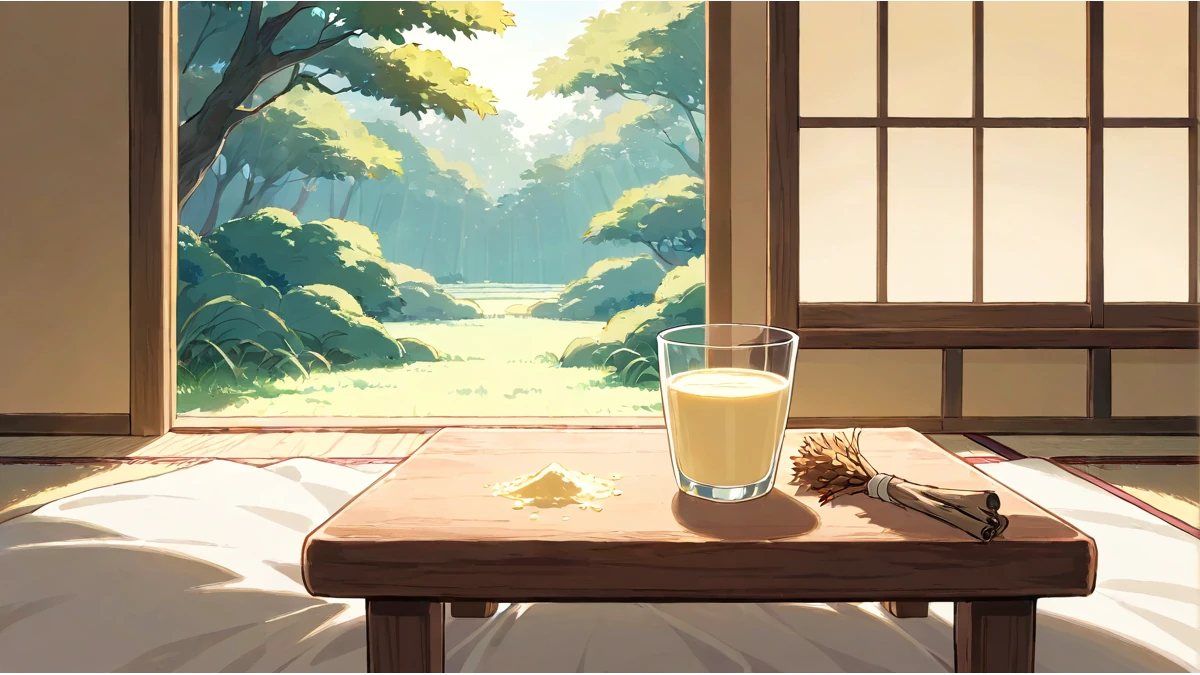
Traditional milk preparation (ashwagandha ghee or ashwagandha milk): The classical Ayurvedic preparation involves boiling the root powder in milk, sometimes with ghee (clarified butter) and honey. The milk carries fat-soluble withanolides, and the sweet creamy medium reduces the sharp taste. Still used traditionally in South Asian households. In Japan, ashwagandha latte preparations have appeared in the supplement market, mirroring this tradition.
Timing for sleep: Some practitioners recommend taking ashwagandha in the evening for sleep applications. The sleep-supporting RCTs used split dosing (morning and evening) rather than a single evening dose, so there is no strong evidence that timing matters significantly.
Dose note: For generic ashwagandha supplements without withanolide standardisation, dose guidance is uncertain. The clinical doses are tied to specific extracts with known compound content. An unstandardised root powder at 1 teaspoon daily may deliver variable withanolide content and cannot be directly compared to the RCT evidence.
Could you grow this yourself?
Potentially, in warm parts of Japan.
Ashwagandha is a subtropical plant preferring temperatures above 20°C, full sun, and well-drained soil. It does not tolerate frost. In Okinawa and the warmer parts of Kyushu, it can be grown as a warm-season crop. In central Honshu, it is a summer annual that dies with cold.
The root is harvested in its first or second year of growth in autumn, before full dormancy. The plant is not difficult to grow where the climate is appropriate. The challenge in Japan is that the growing season in most of the country is too short for substantial root development.
For most Japanese users, purchasing standardised extract is more practical than home cultivation.
Ashwagandha (アシュワガンダ) in Japan
Ashwagandha arrived in Japan through the Ayurvedic supplement wave that expanded through the 2010s. It does not have a traditional Japanese medicinal history — it is not in kampo, not in the Japanese Pharmacopoeia as a traditional crude drug, and has no classical Japanese name.
The supplement market positioned it primarily in two categories: stress and sleep management, and sports performance. Both categories have significant Japanese consumer bases. The cortisol evidence and the sleep trial results provided the rational-supplement angle that Japanese consumers generally respond to — specific biomarkers, measurable outcomes, not just traditional use.
Ashwagandha in Japan is often sold alongside brahmi and triphala in Ayurvedic supplement lines, where the framing is “Indian traditional medicine meets modern research.” Some domestic Japanese brands have incorporated ashwagandha into sleep formulas and adaptogen blends. KSM-66, the standardised extract used in most clinical research, is available through supplement retailers and online.
There is no Japanese traditional relationship with the plant analogous to its 3,000-year Ayurvedic history. It is an adoption, recent and continuing. The adoption is happening for the same reasons it happened in Western supplement markets: the research is real, the applications are common, and the name is memorable.
Things you’re probably wondering
What does the name actually mean? Ashwa (horse) + gandha (smell) — the root smells like a horse stable. The same name implied the horse’s strength would come with it. Somnifera is Latin for sleep-bearing. Both meanings were intentional.
Is it related to ginseng? No. Ashwagandha is in Solanaceae (tomatoes, peppers, potatoes). Panax ginseng is in Araliaceae. The ‘Indian ginseng’ marketing name means ‘adaptogenic tonic herb from India,’ not a botanical relationship. The active compounds are completely different.
What do the clinical trials show? The Chandrasekhar 2012 RCT measured serum cortisol directly (an unusual feature in adaptogen literature). The Langade 2019 trial examined sleep quality scores. Physical performance is supported across multiple trials. Cognitive effects are positive but modest. The research is genuinely better than most adaptogen literature.
What is the difference between KSM-66 and Sensoril? KSM-66 is root-only, standardised to 5% withanolides. Sensoril is whole-plant (root + leaves), standardised to 10% withanolides — the higher concentration means a lower quantity is used per serving. Most clinical trials used KSM-66. They are not directly comparable.
Where can you find it in Japan? Supplement retailers and natural food stores as standardised extract capsules (アシュワガンダ). Online from supplement importers. Increasingly in domestic Japanese stress and sleep formulas.
Botanical details
| Field | Detail |
|---|---|
| Family | Solanaceae |
| Species | Withania somnifera (L.) Dunal |
| Related species | W. coagulans (used in dairy coagulation), W. aristata |
| Life cycle | Perennial shrub |
| Native range | India, North Africa, Mediterranean, Middle East |
| Major producers | India (Rajasthan, Madhya Pradesh), North Africa |
| Japan | Supplement market; not traditional kampo ingredient; growing availability |
| Part used | Root |
The full compound list
| Compound | Class |
|---|---|
| Withaferin A | Withanolide |
| Withanolide A | Withanolide |
| Withanolide B | Withanolide |
| Withanolide D | Withanolide |
| Withanolide G | Withanolide |
| Withasomniferin A | Withanolide |
| Withasomniferol A | Withanolide |
| Withasomniferol B | Withanolide |
| Withasomniferol C | Withanolide |
| Withanoside I | Withanolide glycoside |
| Withanoside II | Withanolide glycoside |
| Withanoside IV | Withanolide glycoside |
| Withanoside V | Withanolide glycoside |
| Sitoindoside VII | Glycowithanolide |
| Sitoindoside VIII | Glycowithanolide |
| Withanine | Alkaloid |
| Somniferine | Alkaloid |
| Somnine | Alkaloid |
| Withasomnimine | Alkaloid |
| Anaferine | Alkaloid (piperidine) |
| Hygrine | Alkaloid |
| Choline | Quaternary ammonium |
| Stachydrine | Quaternary amino acid |
| β-sitosterol | Phytosterol |
| Scopoletin | Coumarin |
| Chlorogenic acid | Polyphenol |
| Iron | Mineral |
See Also
- Brahmi — frequently combined with ashwagandha for stress and cognitive support; also Ayurvedic rasayana tradition
- Eleuthero — the other primary adaptogen with HPA axis effects; different chemical class
- Schisandra — another adaptogen with liver-protective and stress-axis effects; often combined with ashwagandha in formulas
References
- Chandrasekhar, K. et al. (2012). A prospective, randomized double-blind, placebo-controlled study of safety and efficacy of a high-concentration full-spectrum extract of ashwagandha root in reducing stress and anxiety in adults. Indian Journal of Psychological Medicine, 34(3), 255–262.
- Langade, D. et al. (2019). Efficacy and safety of ashwagandha (Withania somnifera) root extract in insomnia and anxiety. PLOS ONE, 14(9), e0222917.
- Wankhede, S. et al. (2015). Examining the effect of Withania somnifera supplementation on muscle strength and recovery. Journal of the International Society of Sports Nutrition, 12, 43.
- Pratte, M.A. et al. (2014). An alternative treatment for anxiety: A systematic review of human trial results reported for the Ayurvedic herb ashwagandha (Withania somnifera). Journal of Alternative and Complementary Medicine, 20(12), 901–908.
- Mirjalili, M.H. et al. (2009). Steroidal lactones from Withania somnifera: An integrated review on the chemistry and pharmacology. Molecules, 14(6), 2373–2393.